
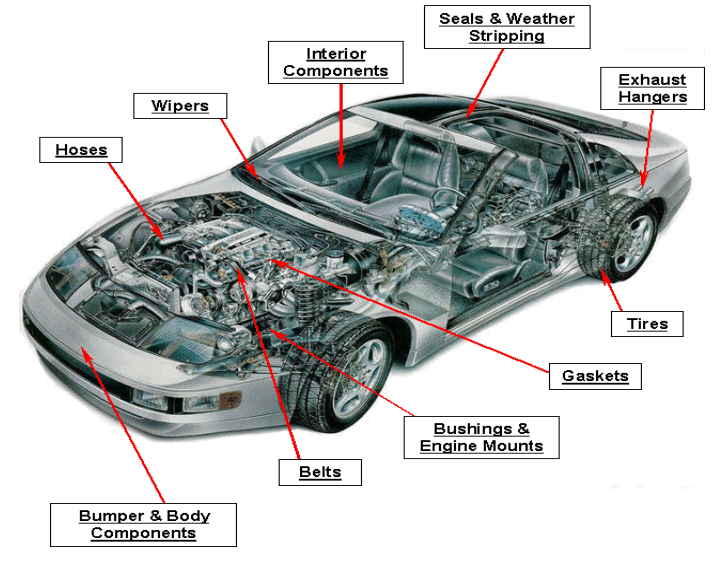
Cars are intricate machines made up of countless parts, each serving a specific purpose to ensure smooth operation. Understanding car parts not only helps you appreciate the engineering behind vehicles but also aids in their proper maintenance and repair. In this article, we’ll break down the essential car parts and their functions.
1. Engine
The engine is the heart of the car, providing the power needed for movement. It converts fuel into mechanical energy, and this energy powers the wheels. The engine contains many subcomponents, including cylinders, pistons, crankshafts, and camshafts.
- Cylinders: These are where fuel combustion takes place, generating power.
- Pistons: They move up and down in the cylinders to create mechanical energy.
- Crankshaft: It converts the up-and-down motion of the pistons into rotational energy.
- Camshaft: This controls the timing of the engine's intake and exhaust valves.
2. Transmission
The transmission is responsible for transferring the engine's power to the wheels. It manages the car’s speed and torque by shifting gears. There are two main types of transmissions: manual and automatic. The transmission ensures that the car can move efficiently at different speeds.
- Manual Transmission: Requires the driver to manually shift gears.
- Automatic Transmission: Automatically changes gears based on the car’s speed.
3. Battery
The battery stores and supplies electrical power to the car’s various electrical components, including the starter motor, lights, and radio. It provides the initial charge needed to start the engine and helps regulate the electrical system when the engine is off.
4. Suspension System
The suspension system is vital for ensuring a smooth ride. It connects the wheels to the car’s frame, absorbs shocks from the road, and maintains tire contact with the surface. Key parts of the suspension include:
- Shock Absorbers: These help dampen the impact of bumps and uneven surfaces.
- Struts: Integrated into the suspension, struts support the vehicle's weight and improve handling.
- Springs: They absorb energy from road bumps, keeping the car stable.
5. Brakes
The braking system is one of the most important safety features of a vehicle. It’s made up of several components that work together to slow down or stop the car. These include:
- Brake Pads: These apply pressure to the rotors to stop the vehicle.
- Brake Rotors: Flat discs that the brake pads press against.
- Brake Fluid: The hydraulic fluid that allows the braking system to operate.
- Calipers: Devices that press the brake pads against the rotors.
6. Cooling System
The cooling system regulates the engine's temperature, preventing it from overheating. The key components of the cooling system are:
- Radiator: A heat exchanger that cools down the engine coolant.
- Coolant: A liquid that circulates through the engine and radiator to absorb and dissipate heat.
- Water Pump: Moves coolant through the engine and radiator.
7. Exhaust System
The exhaust system is responsible for removing gases produced by the engine’s combustion process. It channels exhaust gases safely out of the vehicle, reducing harmful emissions. Key parts of the exhaust system include:
- Exhaust Manifold: Collects gases from the engine's cylinders and directs them to the exhaust pipe.
- Catalytic Converter: Converts harmful gases like carbon monoxide into less harmful substances.
- Muffler: Reduces the noise produced by the engine's exhaust gases.
8. Fuel System
The fuel system stores and delivers fuel to the engine. It includes the fuel tank, fuel pump, fuel injectors, and the fuel filter. The fuel system ensures that the engine receives the correct amount of fuel for efficient combustion.
- Fuel Tank: Stores the gasoline or diesel that powers the vehicle.
- Fuel Pump: Sends fuel from the tank to the engine.
- Fuel Injectors: Distribute fuel to the engine's combustion chambers.
9. Lights and Indicators
The lighting system provides illumination for safe driving at night and in poor visibility conditions. Car lights also act as signals to other drivers. Essential components include:
- Headlights: Provide visibility in the dark and signal the car’s presence.
- Brake Lights: Alert drivers behind you when you are slowing down or stopping.
- Turn Signals: Indicate your intentions to turn or change lanes.
10. Wheels and Tires
Wheels and tires are what connect the vehicle to the road. Tires are essential for traction, handling, and comfort. The wheels hold the tires in place and are crucial for driving stability. Maintaining proper tire pressure and checking for wear and tear are essential for safety.
11. Steering System
The steering system allows the driver to control the direction of the vehicle. It’s composed of several components, including:
- Steering Wheel: The device the driver uses to control the direction of the car.
- Rack and Pinion: The mechanism that turns the wheels when the steering wheel is rotated.
- Tie Rods: Connect the steering rack to the wheels.
12. Air Conditioning and Heating System
The air conditioning (AC) and heating systems regulate the interior temperature of the vehicle. They provide comfort for the driver and passengers by adjusting the climate. The AC system also helps to defog the windshield in humid conditions.
- Compressor: Pressurizes refrigerant and circulates it through the AC system.
- Heater Core: Uses engine heat to warm the cabin.
13. Windshield Wipers and Washer System
This system is essential for maintaining visibility during rain or snow. The wipers move across the windshield to clear away water, while the washer system dispenses cleaning fluid to aid in the process.
- Wiper Blades: Rubber blades that sweep across the windshield.
- Washer Pump: Pumps cleaning fluid onto the windshield.
Conclusion
Understanding the parts of a car helps you appreciate the complexity of this everyday machine. From the engine that powers the vehicle to the tires that make contact with the road, each component plays an important role in the car's overall performance. Regular maintenance and timely repairs can extend the life of your vehicle and ensure it remains safe and efficient to drive. Whether you're a car enthusiast or just a driver, having knowledge of 汽車零件查詢 is always beneficial!